CASE STUDY / HEALTHCARE / MONTREAL
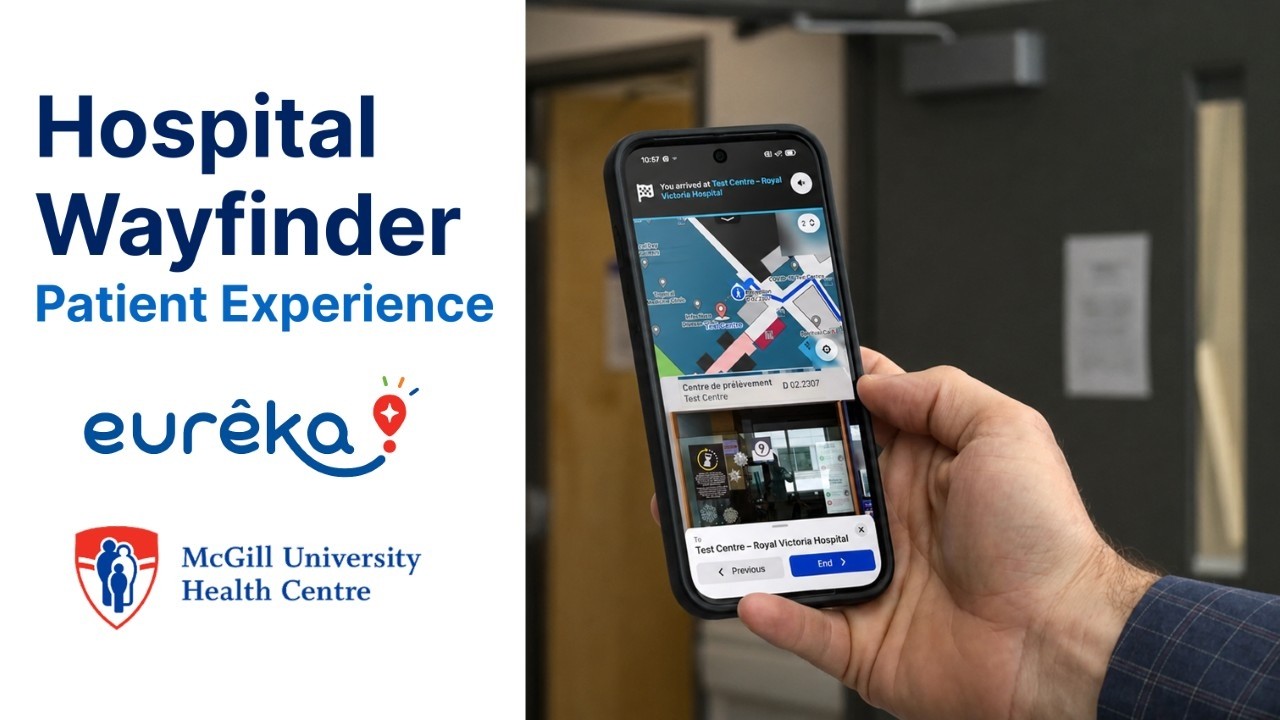
The McGill University Health Centre (MUHC) launched Eurêka, the Glen site’s digital wayfinding system, on June 16, 2026. Designed by Eye-In Media, Eurêka guides patients and visitors with a blue dot through Blocks C and D, which house the Royal Victoria Hospital, the Montreal Chest Institute and the Cedars Cancer Centre. The tool opens in a web browser, in French or English, with no app or account required, and was funded by the MUHC’s Users’ Committee.


01 / LAUNCH
June 16, 2026
Official launch
02 / CAMPUS
250,500 m²
Glen site, 2,800+ parking spaces
03 / ACCESS
QR codes
No kiosks, no app to download
04 / PARTNER
MUHC Users’ Committee
Project funding
01 / THE CONTEXT
A community hospital, a bilingual community and thousands of appointments

Lakeshore General Hospital serves Montreal's West Island from its location in Pointe-Claire. It is part of the CIUSSS de l'Ouest-de-l'Île-de-Montréal, which brings together several healthcare facilities across the territory.
Every day, patients arrive for an outpatient appointment, a test or a visit with a loved one who is in hospital. Many come only once or twice a year: they are unfamiliar with the wings, floors and internal names used for different services.
- Project lead: Major Infrastructure Projects Directorate, CIUSSS de l'Ouest-de-l'Île (Emmanuelle Legros)
- Technology partner: Eye-In Média, Montreal
- Go-live: September 2024, still active
- No app to download: everything runs through a web browser
01 / THE CHALLENGE
What problem did the MUHC want to solve?
The Glen site covers 250,500 m² (2.7 million sq. ft.), with more than 2,800 parking spaces. Patients and their families told the MUHC that they were getting lost between buildings and floors, and that these detours were causing them to arrive late for their appointments.
A delay at a clinic affects more than just the patient. It pushes back the next appointment slot—and sometimes an entire team’s day.
02 / THE ORIGIN
Where did the idea come from?
The idea came from patients and families themselves, who reported getting lost between buildings and floors and arriving late for their appointments. The MUHC Users’ Committee, which represents patients at every healthcare facility in Quebec, funded Eurêka and helped develop it.
The committee identified the priority destinations: clinics, radiology, ultrasound, chemotherapy, radiation therapy and common areas.
“We targeted every location that patients or visitors might need to reach.” Pierre Hurteau, chair of the MUHC Users’ Committee (The Canadian Press)
03 / THE SOLUTION
How does the navigation work?
Patients select their destination and then follow 4 steps.
The tool works directly in a phone’s web browser, with no app or account required. From home, the same tool can be used to plan a visit on a computer: users can locate the entrance, parking area and clinic before leaving.
Open Eurêka
Scan a QR code or go to eureka.cusm.ca.
Search
Search for a destination by service name, such as “radiology.”
Choose a starting point
Select a starting point.
Follow the blue dot
Follow the step-by-step directions, with a blue dot showing your position on the map as you walk.
05 / THE RESULTS
Two years in service, with public results
Between September 2024 and June 2025, the tool was continuously monitored. These figures are public and come from an article published by Caisse Desjardins du Réseau de la santé.
85
unique users / day
25,000+
uses
4.5 / 5
user rating
04 / DELIVERY
How was the project delivered?
The project was completed in six phases: defining the priority destinations with the Users’ Committee, conducting on-site surveys of Blocks C and D, calibrating the blue dot, creating bilingual content, deploying QR codes and training volunteers, followed by the public launch on June 16, 2026.
Glen site volunteers were trained to use Eurêka and promote it on-site, alongside the QR codes and website.
05 / THE RESULTS
What results have been seen since the launch?
Patients and visitors can now find their way through Blocks C and D with Eurêka, without a kiosk or an app to download. The MUHC is already planning a similar project for the Montreal Children’s Hospital later in 2026.
“Even though there is a volunteer system, people do not necessarily see the volunteers when they enter.” Pierre Hurteau, chair of the MUHC Users’ Committee (The Canadian Press)
Does the tool replace volunteers?
No. Volunteers remain at Station S1, near the entrance to the Royal Victoria Hospital, and have been trained to use Eurêka. People who can navigate independently can do so on their own, while volunteers can spend more time with those who need personal assistance.
In the media
MEDIA COVERAGE
The Canadian Press
Digital tools help patients find their way
MEDIA COVERAGE
MUHC
It’s finally here! Eurêka! The Glen site digital wayfinding system
What this project demonstrates for your healthcare facility
01
No campus is too large
A 250,500 m² (2.7 million sq. ft.) campus can be covered by a blue dot, with no app to download.
02
Users can lead the way
A users’ committee can fund and lead a wayfinding project-not just comment on it.
03
Start without kiosks
You do not need kiosks to get started: QR codes and the web are enough for a large-scale rollout.
04
Grow in phases
The project is expanding in phases: an initial group of hospitals, followed by the Montreal Children’s Hospital.
Bilingual service is managed in a single tool, with one URL for each language (eureka.cusm.ca, eureka.muhc.ca).
To hospital leaders, users’ committees and IT teams: if your patients arrive late because they get lost, there is a solution.
Frequently asked questions
- What is Eurêka?
Eurêka is the digital wayfinding system for the MUHC’s Glen site in Montreal. Designed by Eye-In Media and launched on June 16, 2026, it guides patients with a blue dot to the Royal Victoria Hospital, the Montreal Chest Institute and the Cedars Cancer Centre.
- Do I need to download an app to use Eurêka?
No. Eurêka opens in a web browser through a QR code or at eureka.cusm.ca, with no app or account required.
- How does a blue dot work in a hospital without an app?
The phone’s web browser displays the user’s position as a blue dot on the floor map while they walk, with no beacons to install and no app to download.
- Who funded Eurêka?
The MUHC Users’ Committee, in response to patients and families who were arriving late for appointments because they could not find their way.
- Which areas of the Glen site does Eurêka cover?
Adult outpatient services on the first three levels of Blocks C and D, the most frequently visited areas on the other floors, and the underground parking area.
- Can a wayfinding system be used without installing kiosks?
Yes. At the Glen site, access is provided through QR codes and the web. Kiosks can be added later at the main entrances.
- Is the tool bilingual?
Yes. Eurêka is available in French (eureka.cusm.ca) and English (eureka.muhc.ca).
Other healthcare case studies
SHERBROOKE
CHUS – Fleurimont Hospital
Wayfinding tool delivered in under 4 months, funded by the CHUS Foundation
MONTREAL
Lakeshore General Hospital
Interactive kiosk with mobile transfer
Back to: Interactive wayfinding for hospitals and clinics